
In Honor of My Ultimate Gem
on International Women’s Day and Albanian Mother’s Day
March 8, 2026
The Sleeping Beauties of the Deep
Reflections from Yale Peabody & Bruce Museum

Gogotte
The earth keeps secrets the way the old keep memories pressed close, held in darkness, never spoken of unless you know where to listen.
Beneath the fields where cattle graze and children run barefoot through summer grass, beneath the roots of oaks that have watched centuries pass without blinking, beneath mountains, the world holds its breath around something extraordinary. The gems lie there, patient and still, dressed in the plain brown robes of common stone, indistinguishable from everything around them.

Celestite
Sleeping beauties, every one.

Fluorite
They were born in violence.
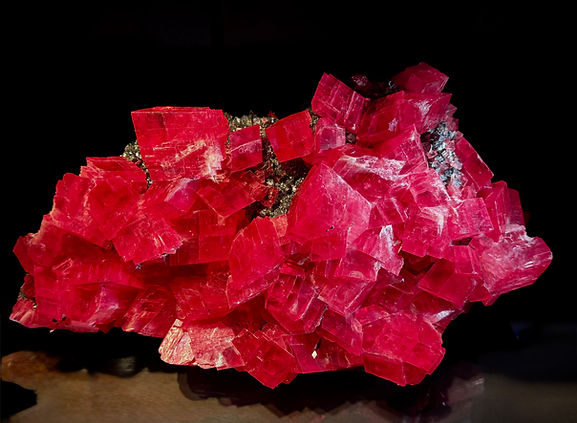
Rhodochrosite
Rubies came from moments when the earth folded itself in half, when mountains rose screaming from ocean floors and heat so tremendous it had no name pressed aluminum and oxygen together until something new, something red, crystallized in the dark. That red is not the red of roses or of blood. It is deeper. It is the red that fire dreams about.

Fluorite
Emeralds grew slower, in the long conversations between hot water and cool rock, between mineral and time. Chromium wandered in, uninvited, and stayed forever, painting every facet the green of a forest seen from above on a clear morning, layered, alive, improbably vivid.

Sapphires are the color of the sky at the exact moment between dusk and night, that brief and holy blue that lasts only seconds above you but lasts millennia underground, locked in corundum, waiting.

And diamonds.
Diamonds are simply carbon that refused to give up.
Pressed at depths where no living thing has ever gone, squeezed under the weight of thirty miles of rock, they became something that light cannot ignore.
For millions of years, they sleep.


Wrapped in their blankets of schist and limestone, foiled in clay and quartz and unremarkable sediment, they rest without dreaming. Seasons do not reach them. Ice ages come and go like weather. Oceans fill and drain. Above them, the world invents itself over and over, first with ferns the size of buildings, then with creatures that shake the ground, then with a peculiar, restless animal that eventually learns to dig.
And still they sleep.
There is a moment, always just a moment, when the first human hand closes around a gem pulled from the earth, and everything changes.
It is covered in grit.
It is dull.
It does not yet know it is beautiful.
Neither, perhaps, does the miner, turning it over with a calloused thumb, holding it toward the light with something caught between exhaustion and wonder.


But light knows.
Light has always known.
It enters the crystal
and the crystal holds it,
bends it,
bounces it
from facet to facet until it comes back out changed, scattered into its constituent colors, each wavelength sent in a different direction.
The stone throws
red from one face,
violet from another,
a green so sharp it seems to hum.
It does with light what a prism does,
what a raindrop does:
it tells the truth about what white light
is secretly made of.

People have gone to war over this.
They have crossed oceans, climbed mountains, spent lifetimes in the dark earth chasing it. Empires were financed by sapphires. Queens were buried with emeralds pressed against their hearts like love letters. Men have killed for rubies no bigger than a thumbnail.
It seems almost foolish, until you hold one up and the light falls through it and your breath catches in a way you cannot explain. Not with logic. Not with economics. Only with the wordless, animal recognition that you are looking at something the earth made beautiful on purpose, over an unimaginable span of time, in absolute silence and absolute dark.
Tonight, somewhere deep below a mountain you have never visited, a gem you will never see is sleeping in its cradle of stone.
Its color is extraordinary.
Its clarity is perfect.
In the geometry of its crystal lattice, every angle is exactly right, as if someone deliberate made it so. The earth is quiet around it.
The darkness is complete.
It is waiting, without knowing it waits, for the light.


Even beyond Earth,
stone remembers.
The Nakhla meteorite fell into Egypt on June 28, 1911, an unassuming rock that would later be revealed as a fragment of Mars. Trapped within it were gases that could only have come from the Martian atmosphere, sealed during a violent impact that launched the stone into space and, eventually, to Earth.
Like gems pulled from the ground,
it arrived dull and ordinary,
carrying a hidden brilliance only science, and light, could uncover.
Nakhla
Stony meteorite, Martian achondrite, nakhlite
Egypt, fell June 28, 1911
Pyrite & Calcite
Amethyst
Malachite & Smithsonite
Malachite
Desert Rose - gypsum or barite
INFO: Messengers from Space
Meteorites are ancient rocks or metals from space that land on planets like Earth, the Moon, or Mars. Their preserved minerals hold unique clues about how our solar system formed billions of years ago. Classified as stony, stony-iron, or iron, of which the stony variety is most common, most meteorites originate from the asteroid belt between Mars and Jupiter, though some come from comets or are fragments of the Moon and Mars.